

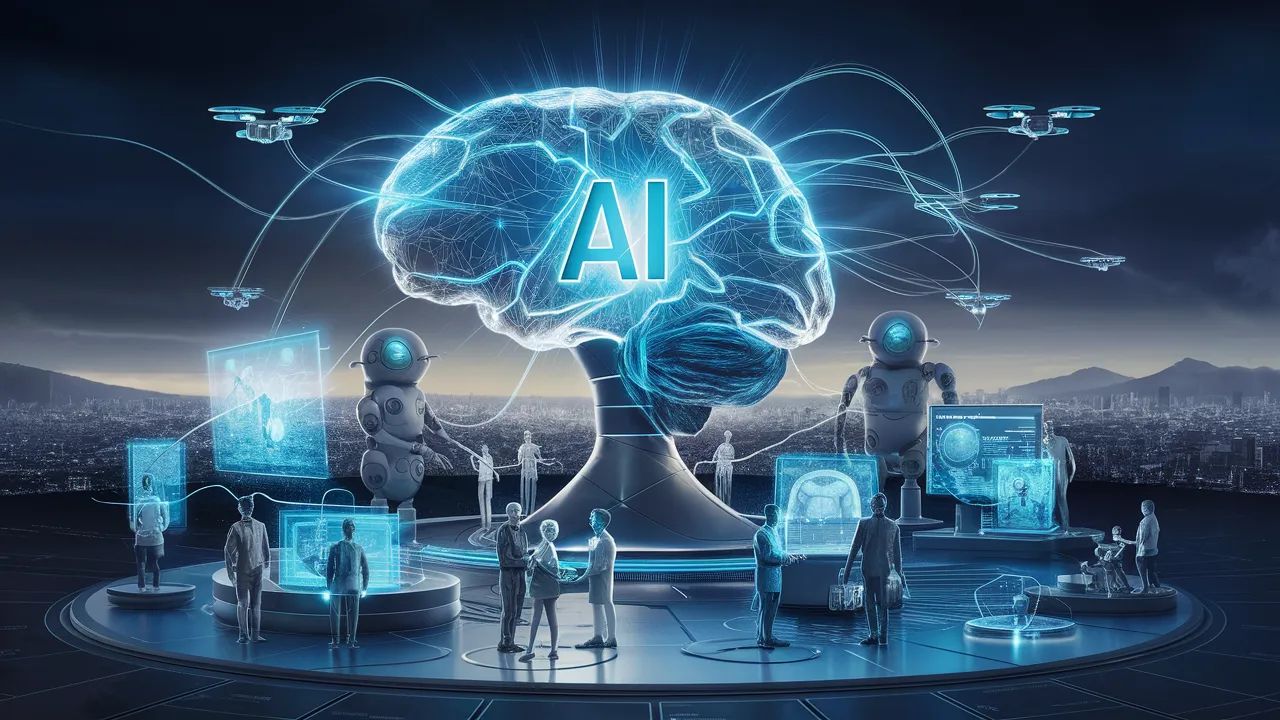
Artificial intelligence has officially graduated from a period of intense experimentation into a phase of structural maturity. In the past, discussions surrounding AI focused heavily on what the technology might do in the future. Today, the focus has shifted entirely to practical, real-world deployment, scalability, and measurable return on investment (ROI).
As businesses and developers move away from isolated tools toward highly integrated systems, keeping an eye on the horizon is essential. The sections below highlight the definitive shifts shaping The Future of AI: Top Artificial Intelligence Trends to Watch right now.
1. The Dominance of Agentic AI and Multi-Agent Workflows
The single most significant trend rewriting the technology landscape is the evolution from generative AI to agentic AI.
For the last few years, interacting with AI required constant human prompting—you ask a question, the AI gives an answer. Agentic AI shifts the paradigm from “chatting” to “doing.”
Modern AI systems operate as autonomous software agents. When given a high-level goal (e.g., “Analyze our Q1 ad spend, find inefficiencies, and adjust the active campaigns”), the system autonomously breaks the goal down into smaller tasks, writes necessary code, browses the web, and executes the workflow across multiple software platforms without needing continuous human intervention.
[Human Intent: "Optimize Q1 Ad Budget"]
               │
               ▼
┌────────────────────────────────────────┐
│        AI Lead Orchestrator            │
└──────────────┬──────────────────┬──────┘
               │                  │
               ▼                  ▼
  ┌────────────────────────┐  ┌────────────────────────┐
  │  Data Analytics Agent  │  │   Content Gen Agent    │
  │  (Scans budget data)   │  │  (Rewrites low-ad CTR) │
  └────────────────────────┘  └────────────────────────┘
The Data: According to industry data from Gartner, more than 40% of organizations have already deployed AI agents into active production environments, handling complex enterprise tasks with a success rate that has climbed to over 77%
2. The Trillion-Dollar Pivot to Pragmatic AI and ROI
The era of funding tech companies based purely on AI hype has concluded. Venture capital and corporate investments have executed a massive pivot toward practical business outcomes.
Instead of pouring resources exclusively into the astronomical compute costs required to train massive, general-purpose baseline models, global spending has flipped toward inference—the cost of running optimized models at scale to solve niche, industry-specific workflows.
Organizations are using smaller, highly specialized models fine-tuned on proprietary corporate data. This approach yields significantly higher accuracy, lowers data latency, and reduces energy consumption compared to massive monolithic models.
3. “AI is Eating Software” via Intent-Driven Development
The traditional software development lifecycle is undergoing its most radical transformation since the invention of open-source coding. The paradigm is shifting rapidly from manually writing syntax to expressing high-level intent.
Software engineers now function as architectural orchestrators. They define the inputs, guardrails, and expected behavioral outcomes of an application, while AI assistants autonomously generate code blocks, run continuous integration pipelines, catch security vulnerabilities early, and handle legacy system updates behind the scenes.
4. Hybrid Infrastructures and the Rise of “AI Superfactories”
As AI workloads scale globally, classical cloud architectures are struggling to keep up with the processing demand. This friction has birthed a major infrastructure trend: globally interconnected, hyper-dense systems frequently referred to as AI Superfactories.
To balance performance with regional regulatory compliance and cost, enterprise workloads are rapidly moving toward a hybrid model combining:
- Specialized private cloud infrastructure for handling sensitive, proprietary data.
- Distributed public cloud networks to handle elastic computing spikes.
- Sovereign cloud frameworks designed to keep localized user data completely within national borders.
Trend Summary Comparison
| AI Trend Focus | Primary Catalyst | Core Business Impact |
| Agentic AI | Deep learning success rate jumps; advanced task planning. | Shifts human labor away from routine execution into strategic oversight. |
| Pragmatic ROI | Escalating training costs; market demand for profitability. | Drives adoption of smaller, highly secure, domain-specific models. |
| Intent-Driven Dev | AI accuracy in codebase contextual mapping. | Massive reduction in software debugging time; faster product launches. |
| Hybrid Cloud 3.0 | Global data privacy laws; compute power density demands. | Allows low-latency AI processing while maintaining strict data governance. |
The Takeaway: Reshaping More Jobs Than Replacing
As the future of artificial intelligence unfolds, the data suggests that AI will materially reshape how work gets done rather than simply automating human positions out of existence. Industry forecasts from the Boston Consulting Group indicate that over 50% of global roles will be fundamentally altered over the next few years. Success belongs to the businesses and professionals who treat AI not as a temporary digital helper, but as an foundational collaborative partner.

